microRaman spectroscopy data of the Scream (1910?)
Creators
Description
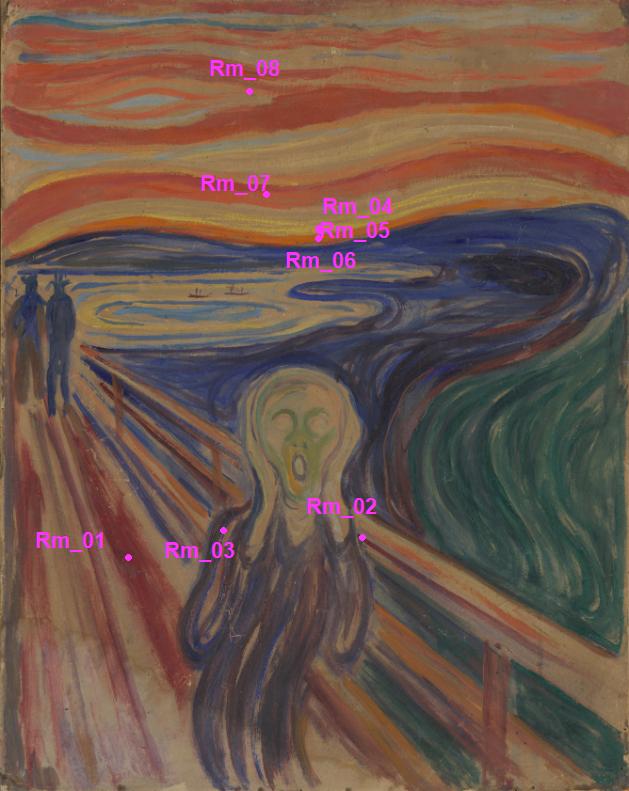
microRaman data of the Scream (1910?, tempera and oil on cardboard) from MOLAB campaign in 2017, performed at Munch museum.
Files
Scream 1-Raman points.jpeg
Files
(355.1 kB)
| Name | Size | Download all |
|---|---|---|
|
md5:74c06288aa2594939f340bbfbc8c7a32
|
63.9 kB | Preview Download |
|
md5:540bd3308e21bcedba432be38c461e0a
|
32.6 kB | Preview Download |
|
md5:a01c6daba7ac3605826aba6b62413a9c
|
32.1 kB | Preview Download |
|
md5:9882a4c4a6e20ccadfc777915d3cbdfb
|
32.1 kB | Preview Download |
|
md5:16b9cc33399e8a21cc1e9db23d47ab0f
|
33.1 kB | Preview Download |
|
md5:232dc94ed9e8eb3faab5b0aee371dd28
|
32.5 kB | Preview Download |
|
md5:9e501dc960b2b8ff369f9c51f0104c6f
|
31.8 kB | Preview Download |
|
md5:ffcd29fb5bef4771ecbfd8628912126c
|
32.7 kB | Preview Download |
|
md5:b4dbb34f1a6afe91595e1a525f4c1f1f
|
32.1 kB | Preview Download |
|
md5:44550b46e8f1a11c4e6b25087831668a
|
32.1 kB | Preview Download |
Additional details
Research focus
- Research focus Title
- Scream (1910?)
- Research focus Category
- Object/artwork
- Research focus Description
-
The microRaman data of this version of the Scream have been acquired during a MOLAB campaign, as access granted by IPERION CH facilities, for the project: TECH_SCREAM_TECH – TECHnical Study of CoRE Art Materials & TECHniques of SCREAM versions (research group from Munch museum, led by Irina Sandu).
Research activity
- Research Activity Type
- Object Examination/Scientific analysis
- Technique
- Micro-Raman spectroscopy
- Technique Category
- Point analysis
- Method Description
-
Raman spectroscopy is a molecular vibrational spectroscopic technique which provides complementary information to FTIR. It is used in the cultural heritage field for the vast identification and characterization of inorganic and/or limited organic materials. The main drawback of this technique is related to high fluorescence emissions which may compete with the scattering phenomena and cover any useful vibrational signals. However, to overcome this limitation we provide portable Raman instrumentations with multiple laser excitations at 532nm, 785nm and 1064nm which are interchangeable according to the object under study. Namely the 532nm laser system in a micro-Raman set-up is particularly adapt to low fluorescing inorganic based substrates, such as ceramics, bronzes and stone materials. The longer wavelength lines at 785nm and dispersive 1064nm favour the examination of organics (synthetic dyes and pigments, numerous natural dyes and pigments) and organic containing matrices, such as paintings (varnished and not) and manuscripts.
- Tool / Equipment (or Software) Description
-
The Jasco portable micro-Raman is equipped with a Nd:YAG laser source emitting at 532 nm. The system is equipped with a CCD ANDOR detector maintained at −50° C with a Peltier cooler. The use of optical fibres, Olympus objectives (50x or 20x), suitable notch filters and a CCD camera which permit the image of the irradiated sample to be visualised. The spatial resolution of this system is 100 μm (20x objective) with a spectral resolution of about 10 cm-1.
The portable Raman spectrometer Rigaku Xantus-2, has lasers operating at 785 and 1064 nm. For the 785 nm laser set-up, the detector is a CCD cooled by a Peltier system and the power ranges from 30- 490 mW with a spectral resolution between 7 -10 cm-1. The 1064 nm laser set-up instead uses an InGaAs detector and has power varying from 30- 490 mW with a spectral resolution of 15 -18 cm-1. The spatial resolution is about 4 mm2.
- Tool / Equipment (or Software) reference
- C. Miliani, F. Rosi, B.G Brunetti, A. Sgamellotti, "In situ Non-invasive Study of Artworks: the MOLAB Multi-technique Approach", Accounts of Chemical Research 43, 2010, pp. 728-738. F. Rosi, V. Manuali, T. Grygar, P. Bezdicka, B.G. Brunetti, A. Sgamellotti, L. Burgio, C. Seccaroni, C. Miliani, "Raman scattering features of lead pyroantimonate compounds: implication for the non-invasive identification of yellow pigments on ancient ceramics. Part II. In-situ characterization of Renaissance plates by portable micro-Raman and XRF", Journal of Raman Spectroscopy, 42, 2011, pp. 407–414.
Supplementary information on Object Examination
- Object Examination Scale
- Micro
- Examination Class or Type
- Single
- Specific Scope linked to the Project
- used to detect pigments and fillers
- Material Category
- pigments and fillers